Causal pathways
One syndrome. Seven ways in.
Occupational Distress Syndrome is not one problem with one cause. It is a shared endpoint that seven different mechanisms can reach. Knowing which ones are active is what makes the right intervention possible.
Why “syndrome”
Syndrome, not disease
A disease has a single identifiable cause. Tuberculosis is caused by Mycobacterium tuberculosis, and treating the disease means addressing that cause.
A syndrome is different. It is a cluster of signs and symptoms that reliably co-occur, produced by any number of upstream mechanisms that converge on the same observable endpoint. Metabolic syndrome is not caused by one thing. It is the convergent result of multiple interacting disruptions to metabolic function.
The burnout literature has been measuring a syndrome for decades while often treating it as though it were a disease. That is how practitioners experiencing moral injury end up offered yoga classes, and people whose resources have been structurally depleted end up offered resilience training.
The intervention is not wrong because yoga is ineffective. It is wrong because it was designed for a different problem than the one it is being asked to solve.
The seven pathways
Different mechanisms, a shared impact
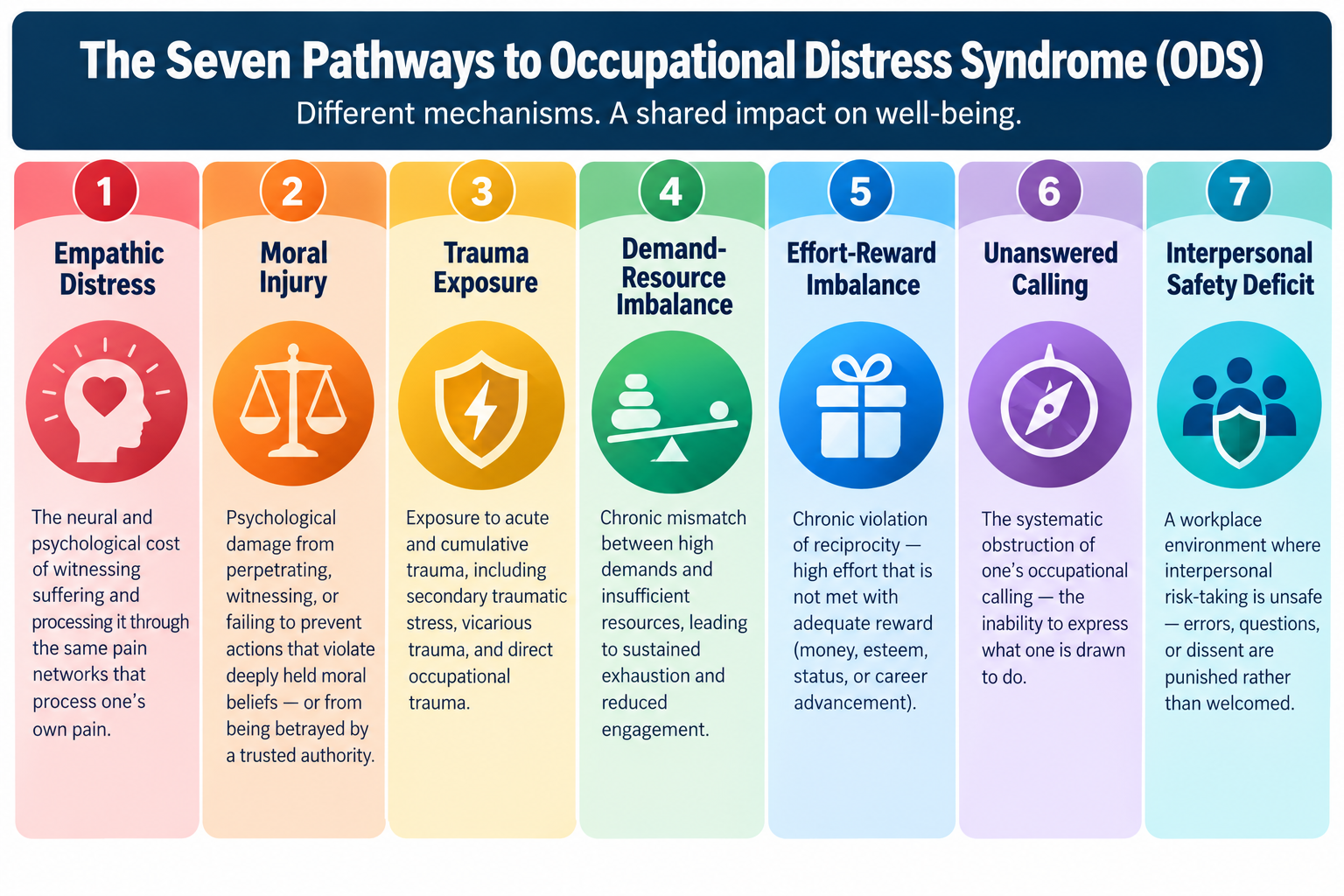
The revised ODS framework names seven upstream pathways that are most consistently supported by the current literature. Each one has its own page with the mechanism, what it damages, and full references.
- Empathic DistressThe neural and psychological cost of witnessing suffering and processing it through the same pain networks that process one's own pain.
- Moral InjuryPsychological damage from perpetrating, witnessing, or failing to prevent actions that violate deeply held moral beliefs, or from being betrayed by a trusted authority.
- Trauma ExposureExposure to acute and cumulative trauma, including secondary traumatic stress, vicarious trauma, and direct occupational trauma.
- Demand-Resource ImbalanceChronic mismatch between high demands and insufficient resources, leading to sustained exhaustion and reduced engagement.
- Effort-Reward ImbalanceChronic violation of reciprocity: high effort that is not met with adequate reward in money, esteem, status, or career advancement.
- Unanswered CallingThe systematic obstruction of one's occupational calling: the inability to express what one is drawn to do.
- Interpersonal Safety DeficitA workplace environment where interpersonal risk-taking is unsafe, and errors, questions, or dissent are punished rather than welcomed.
How they combine
Rarely one at a time
In healthcare settings, several pathways are usually active at once, and they do not operate in isolation. They interact, amplify each other through allostatic load, and form recursive loops that speed the cascade. Two people with the same exhausted endpoint can be carrying very different combinations.
The framework claims utility, not completeness. Additional pathways likely exist beyond the seven named here. As Box and Draper observed, all models are essentially wrong; the practical question is how wrong they have to be to stop being useful.
Interactive tool
See the pathways at work
The ODS Pathway Dysfunction map shows how each causal pathway impairs the well-being architecture. Explore it below, or open it full screen.
Which pathways are active for you?
The assessments are for education and self-reflection, not diagnosis.