Before you read another article about burnout
Is the work costing more than it should?
Four questions. Answer them honestly.
If you recognized yourself in two or more, what you are experiencing has a structure. It has identifiable causes. It is not a personal failure.
And it is not burnout. Not exactly.
The name
It has a name. Occupational Distress Syndrome.
Burnout describes what you look like. It does not describe what is happening to you.
Occupational Distress Syndrome is what happens when the demands of a workplace chronically exceed the internal architecture a person needs in order to function well. It is a syndrome, not a disease, which means several different mechanisms can produce the same exhausted endpoint.
If you answered for your team
Bring this to your team.
A workshop that gives a department or organization shared language for what is happening to it. Participants map their own pathway profile, see which parts of the well-being architecture are carrying the load, and leave with changes that sit inside the unit's own control rather than a list of things leadership should fix someday.
- Built for clinical teams, faculty groups, and leadership
- Delivered on site or remote
- Half day, full day, or a multi-session series
Scheduling and scope are set directly with Dr. L'HommeDieu.
Explainer
Two minutes on what is actually happening
The framework, explained by the clinician who developed it.
The architecture
What we see is not what is damaged
The three symptoms everyone measures sit on the surface. Underneath them is Carol Ryff's well-being architecture, six interconnected dimensions of psychological functioning, and that is where the damage actually accumulates.
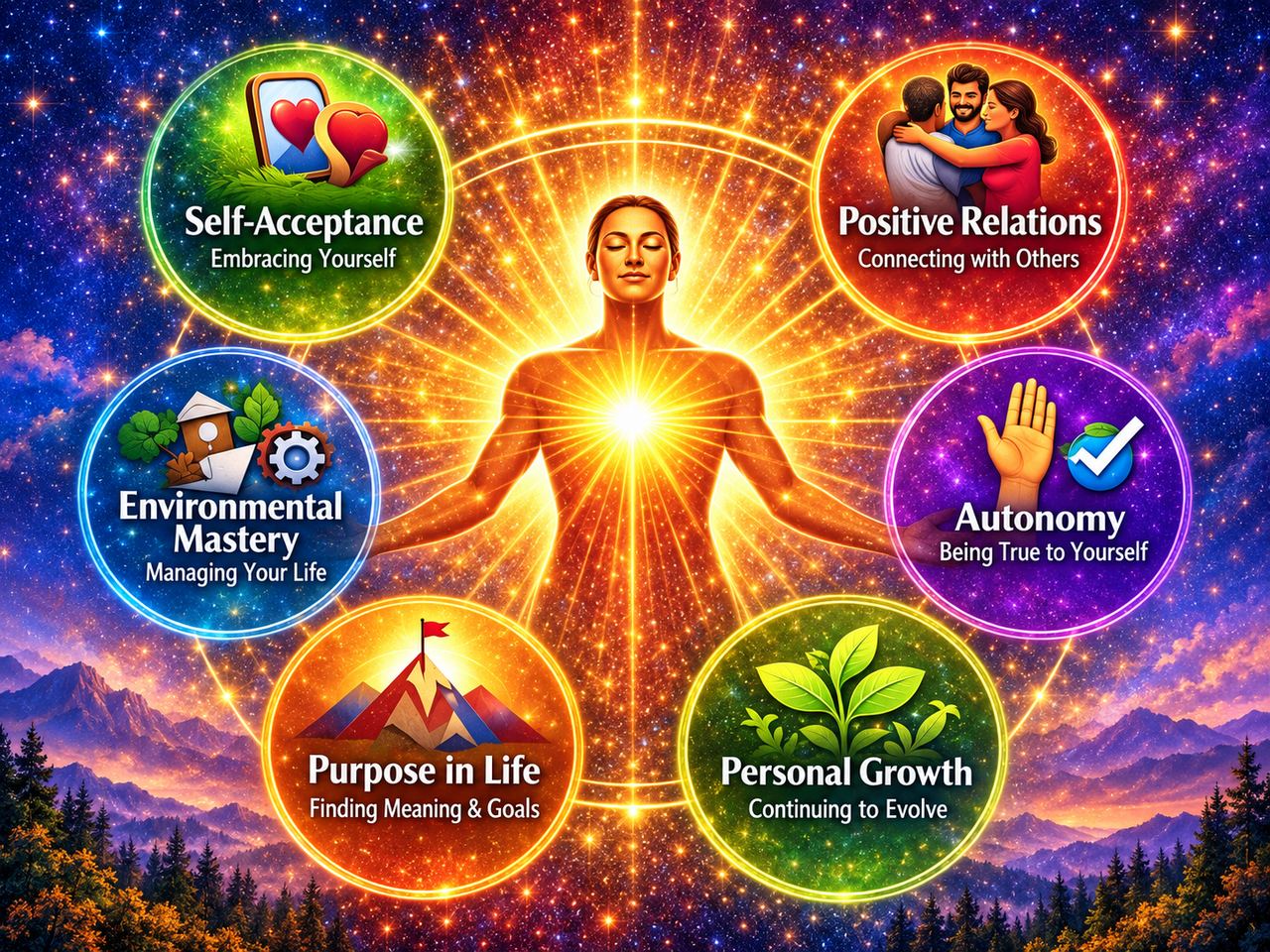
Self-acceptance
A steady positive regard for yourself that holds up even against the parts of your history you would not choose again.
Positive relations with others
Warm, trusting connection, and the capacity to still be moved by another person rather than shielded from them.
Autonomy
Acting from your own standards and judgment instead of from approval, pressure, or protocol you do not believe in.
Environmental mastery
The sense that you can manage the demands in front of you and shape the conditions rather than only absorb them.
Purpose in life
A direction that makes present effort mean something. Losing it is not the same as being tired.
Personal growth
The experience of still developing, still becoming more capable, rather than being finished and maintained.
These dimensions function as interconnected subsystems. When one is under chronic stress the disruption cascades. When one is strengthened the improvement propagates. That is the reason intervention is possible at all.
Causal pathways
Seven ways in
Each of these can produce the same exhausted endpoint. Most people are carrying more than one, and they amplify each other.
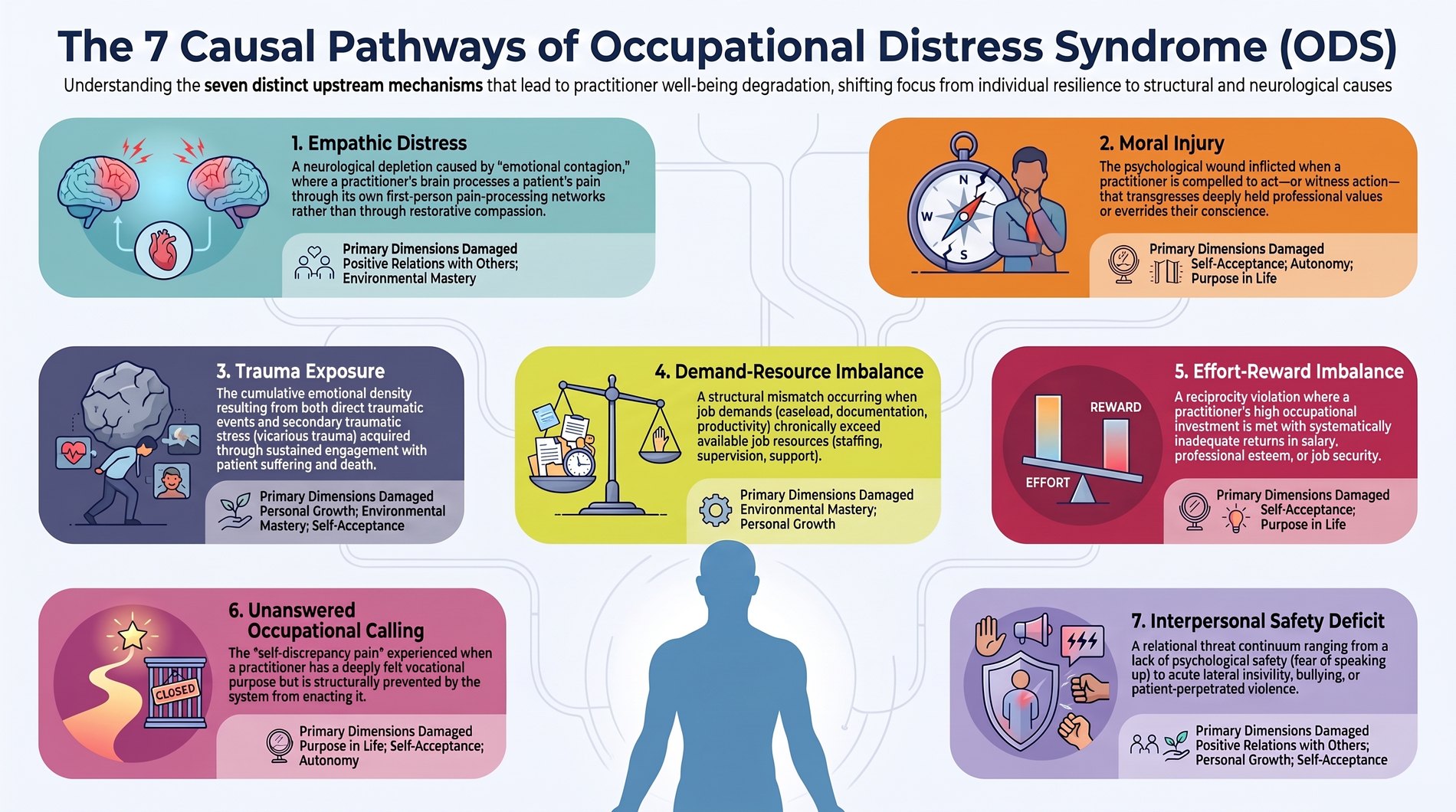
You do not arrive at work as a blank surface. Personal stressors, background vulnerabilities, and existing conditions load the same architecture from outside the workplace. ODS interacts with that background rather than operating in isolation. Read about the background architecture.
For your field
The framework is the same everywhere. The pressures are not.
Choose the site built for the work you actually do.
Sustainable Teaching
A better word for educator burnout. Name what the classroom is asking of you, with dedicated tracks for K-12 and higher education.
Explore the education siteFOR HEALTHCARESustainable Caring
A more accurate word for clinician burnout. Built for everyone inside healthcare, from frontline clinicians to allied health and leadership.
Explore the healthcare siteInstruments
Find out where you actually are
Three tools, free, no account required.
ODS Assessment
The Copenhagen Burnout Inventory paired with a causal pathway screen, so you learn not only how depleted you are but which mechanisms are driving it.
Open the assessmentPathway dysfunction map
How each external pathway impairs the well-being architecture and produces the observable triad.
Open the mapLKM mitigation pathways
How loving-kindness practice acts on each pathway through Ryff's six dimensions.
Open the mapThe Copenhagen Burnout Inventory is validated. The pathway screen is not, and is offered as a structured way to think about contributing causes rather than as a diagnostic instrument.
These instruments are for education and self-reflection only and do not provide a clinical diagnosis. If you are in crisis, call or text 988 (U.S. Suicide and Crisis Lifeline), contact your local emergency services, or find a crisis line in your country at findahelpline.com.
The intervention
You do not stop caring. The mode through which caring is expressed changes.
Why compassion is the high-leverage move
When you witness suffering and respond with empathy in the ordinary sense of the word, your brain processes that suffering through the same networks that process your own pain. Sustained across years of clinical work, that produces depletion.
Compassion is a different neural state, running on affiliation and reward networks, associated with warmth and the motivation to help rather than with pain. It can be trained.
NEURAL
Training shifts access from empathic distress toward compassion. Measurable change in the relevant networks appears after brief training, with downstream effects on stress hormones and inflammatory markers.
COGNITIVE
Durable reframes in how you appraise self, other, and suffering itself. This modifies appraisal before the stress response begins rather than treating its aftermath.
RELATIONAL
A stance in which difficult behavior is understood as the expression of someone else's suffering. It does not excuse harm. It preserves your capacity to respond rather than react.